Future-Ready
Learning Starts Here.
At Robofleet, students learn by building, experimenting, solving problems and seeing their ideas come to life. Our structured learning journey moves from electronics fundamentals to robotics, coding, IoT, Artificial Intelligence and advanced project development.
From curiosity to creation.
Our Grade 3–10 curriculum combines hands-on projects, technology, creativity, coding and problem-solving to help students understand how technology works in the real world.
Students don't just learn concepts. They build circuits, program robots, develop apps, connect smart devices, explore AI and create solutions to practical problems.
Each stage builds on previous learning while strengthening logical thinking, creativity, collaboration and problem-solving.
Eight stages. One connected journey.
Students progress from electronics fundamentals to advanced robotics and AI, with each grade introducing new technologies and building on previous skills.
Basics of Electronics
Students begin their technology journey by understanding the building blocks of electronics and exploring how simple circuits work.
Night Lamp
Build simple functional projects and understand how electronic components work together.
Robotics & Smart Electronics
Students explore how electronics can sense and respond to their surroundings through practical robotics challenges.
Avoider Robot
Create a robot that detects obstacles and responds to its environment.
Robotics with Coding
Students apply programming concepts directly to physical devices and robots, learning how code can make systems sense, decide and act.
App-Controlled Robot
Write code that allows physical systems to sense, decide and act.
App Development
Students discover how software can solve everyday problems through applications, automation and device interaction.
App
Create an application that can control or automate connected devices.
Internet of Things (IoT)
Students explore connected devices, data collection, communication, monitoring and smart systems.
Air Quality Monitor
Build connected solutions that demonstrate how data and devices can work together.
Design Thinking & AI
Students begin exploring AI while learning how to identify problems, generate ideas and develop technology-based solutions.
Classifier
Explore how AI can identify patterns and classify information using images and data.
Artificial Intelligence
Students take a deeper dive into AI and programming while exploring data, project development, ethics and responsible technology use.
Data Analyzer
Create practical AI-powered applications while exploring responsible use of intelligent systems.
Advanced Robotics & AI
Students bring robotics, programming, AI, sensors, automation and cybersecurity together in integrated technology projects.
Smart AI Robot
Design systems that combine physical computing with intelligent decision-making.
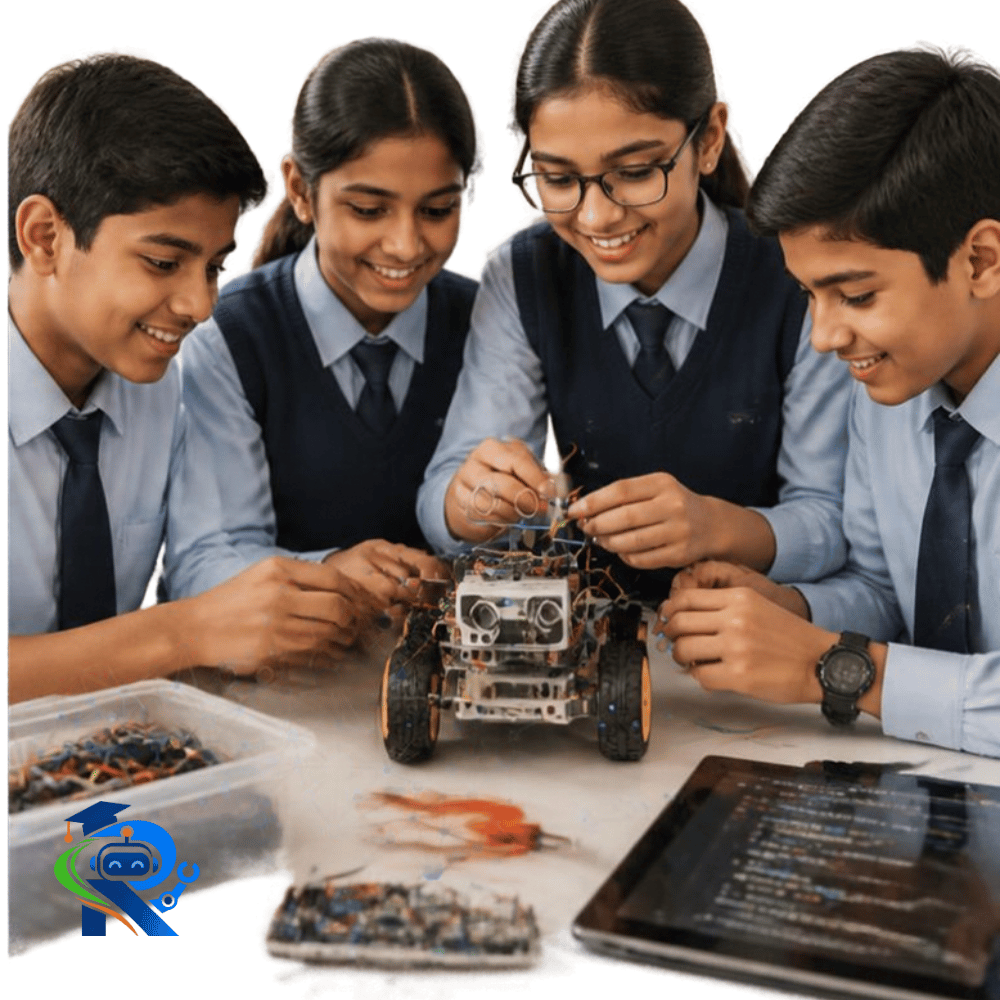
The best way to learn technology is to create with it.
Every stage of the curriculum is supported by practical, hands-on projects. Students learn by using technology rather than simply reading about it.
They discover what a sensor, robot, app or AI model does by actually using it to create something meaningful.
Learn the Concept
Understand the technology and the problem behind the project.
Build the Solution
Connect hardware, software and ideas into a working prototype.
Test, Debug & Improve
Experiment, understand what went wrong and make the solution better.
From idea to working solution.
Students follow a simple learning cycle that encourages experimentation, debugging and improvement.
Learn
Understand the concept.
Explore
Investigate how it works.
Build
Turn the idea into a project.
Test
Observe what happens.
Debug
Find what needs changing.
Improve
Make the solution better.
Create
Apply the learning again.
Every stage prepares students for the next.
The curriculum gradually increases technical depth while continuing to develop problem-solving, creativity and project-building skills.
Discover
Explore electronics, circuits, sensors and the fundamentals of robotics.
Build
Combine coding with physical systems and begin creating apps and automated solutions.
Connect & Think
Explore IoT, connected systems, design thinking and the foundations of AI.
Innovate
Build advanced AI and robotics solutions while exploring ethics, cybersecurity and real-world applications.
Technology becomes meaningful when students solve real problems.
Projects connect classroom concepts with applications students can understand—from smart homes and environmental monitoring to automation, data analysis, AI and intelligent robots.
What problem are we solving?
How can technology help?
How can we design a better solution?
What impact could our solution have?
Technical skills and the ability to think with them.
The curriculum develops technology knowledge alongside the thinking and collaboration skills needed to apply it.
Technical Skills
Future Skills
Give students time to explore technology.
Introducing students to robotics, coding, AI and problem-solving early helps them develop a strong foundation while giving them opportunities to explore how technology works.
Build familiarity with technology through practical, age-appropriate projects.
Develop confidence through experimentation and problem-solving.
Progress from simple physical systems to more advanced robotics and AI concepts.
Understand, build and create with technology—not simply use it.
From the first circuit to the next big idea.
Give students the opportunity to build robots, write code, develop apps, connect devices, explore AI, solve problems and turn ideas into working solutions.
Explore the Curriculum →